Tuesday, 30 August 2016

CONTENTS OF A FIRST AID BOX

What should I keep in my first aid kit?

It's important to have a well stocked first aid kit in your home so you can deal with minor accidents and injuries.

Your first aid kit should be locked and kept in a cool, dry place out of the reach of children.

Many people also keep a small first aid kit in their car for emergencies.

BASIC CONTENTS OF FIRST AID KIT (BOX) 

The basic contents of first aid kit (box) includes:

1.)   Plasters in a variety of different sizes and shapes
2.)   Small, medium and large sterile gauze dressings
3.)   At least two sterile eye dressings.
4.)   Triangular bandages.
5.)   Crêpe rolled bandages
6.)   Safety pins (small and large)
7.)   One packet of disposable sterile latex gloves
8.)   Tweezers.
9.)   Scissors.
10.)  Alcohol-free cleansing wipes
11.)   Sticky tape
12.)  Thermometer (preferably digital)
13.)  Skin rash cream, such as hydrocortisone or calendula cream or spray to relieve insect bites and stings
14.)  Antiseptic cream
15.)  Pain killers such as paracetamol (or infant paracetamol for children),
16.)  Aspirin (not to be given to children under 16 years of age, or ibuprofen.
Cough medicine,
7.)   Antihistamine tablets, (Eg Piriton)
8.)   Distilled water, (for cleaning wounds),
9.)   Eye wash and
10.)  Eye bath.
11.).  Disposable towel
12.).  Pads for bleeding

NOTE:
(i) It is also very important and useful to keep a basic first aid manual or instruction booklet with your first aid kit.

(ii) All medicines in the first aid kit should be checked regularly to make sure they are within their use-by or expiry dates.

(iii). As a matter of Policy schools must
maintain at least one major first aid kit located in the sick bay (Health post / First aid post).
(ix)  Store any medications separately from the first aid kit including any prescribed or non prescribed medication provided by a student’s parent /guardian,  or adult/independent student.

Contents

First aid kit contents should meet the first aid requirements of individual schools.  This table lists the general contents recommended by Ambulance Victoria.

Note: Thermometers are not:

necessary for first aidused in general first aid training according to theNational Health Training Package (First Aid Units of Competency) HLT07 (February 2007).Type of equipmentContent includes

Current first aid manual

one of the following recommended first aid manuals:

First Aid Emergency Handbook from:
- Survival Emergency Products
- local suppliers
- Ambulance Victoria First AidThe First Aid Handbook from Australian Red CrossAustralian First Aid from St John Ambulance Australia.

Wound cleaning equipment

gauze swabs: 100 of 7.5 cm x 7.5 cm divided into small individual packets of five sterile saline ampoules: 12 x 15 ml and 12 x 30 ml disposable towels for cleaning dirt from skin surrounding a wound

Wound dressing equipment

sterile, non-adhesive dressings, individually packed:
- eight 5 cm x 5 cm
- four 7.5 m x 7.5 m
- four 10 cm x 10 cm for larger woundscombine pads: twelve 10 cm x 10 cm for bleeding woundsnon-allergenic plain adhesive strips (‘band aids”), without antiseptic on the dressing, for smaller cuts and grazessteri-strips/wound closures for holding deep cuts together in preparation for stitching non-allergenic paper/adhesive type tape, width 2.5 cm–5 cm, for attaching dressingsconforming bandages for attaching dressings in the absence of tape or in the case of very sensitive skinsix sterile eye pads, individually packed

Bandages

six triangular bandages for:
- slings
-
- attaching dressings
- immobilising injured limbs
- splints etcconforming bandages to hold dressings in place:
- two of 2.5 cm
- two of 5 cm
- six of 7.5 cm
- two of 10 cmcrepe bandages (“hospital weight”) to secure a pad to control bleeding, to support soft tissue injuries (sprains & strains) and for ‘Pressure Immobilisation Bandaging technique’ for snake bite:
- two of 2.5 cm
- two of 5 cm
- six of 7.5 cm
- two of 10 cm
- two 15 cmheavy elastic bandages; two 15cm. These are ideal to use for ‘Pressure Immobilisation Bandaging technique’ for snake bite or severe allergic reaction to other bites and stings.

Injury treatment equipment

one pair of:
- stainless steel scissors (medium size)
- trauma shears (heavy duty scissors for cutting clothing, bandages, shoelaces etc. if required)disposable splinter probes and a sharps container for wastedisposable tweezersfor sprains, strains and bruises, two:
- gel packs, kept in the refrigerator, or
- disposable ice packs for portable kits made from small zip-lock plastic bags filled with water, frozen and wrapped in a cloth/bandage/disposable towel before being applicationflexible ‘sam’ splints for fractured limbs (in case of ambulance delay)additional 7.5 m crepe bandages and safety pins to attach splintsice packs.

Lotions and ointments

sun screen, ideally a low allergenic/sensitive skin type, with a sun protection factor of between 15+ and 30+single use sterile saline ampoules for the irrigation of eyes

Notes:

Creams and lotions, other than those in aqueous or gel form, are not recommended in the first aid treatment of wounds or burns.Antiseptics are not recommended. Cuts and abrasions should be cleaned initially under running water followed by deeper and more serious wounds being cleaned with sterile saline prior to dressing.

Hygiene and cleaning equipment

single use nitrile gloves in various sizes such as small, medium and large
Note: Some people are allergic to latex gloves.blood and vomit spill kitsdisposable hand towelsadhesive sanitary pads, as a backup for personal suppliesantiseptic hand wash/germicidal soap and nail brush for hand-cleaning before and after treatment onlysingle use antiseptic wipes for hand cleaning when water is not readily availableone box of paper tissuespaper towel for wiping up blood spills in conjunction with blood spill kitsingle use plastic rubbish bags that can be sealed, for used swabs a waste disposal bin suitable for taking biohazard waste
Note: Biohazard waste should be burnt. There are several companies that will handle bulk biohazard waste.ice cream containers or emesis bags for vomit.

Other equipment

resuscitation face mask such as “pocket mask” type that can be cleaned/reused one medicine measure for use with prescribed medications disposable cups
One teaspoon
pen-like torch, to measure eye-pupil reaction blanket and sheet, including a thermal accident blanket for portable kits possibly a generic EpiPen® for treating anaphylaxis sufferers see: Anaphylaxis within Related policies

Friday, 26 August 2016

MODERN SPILL KITS / SPILL CONTROL MATERIALS / DEVICES FOR PLANTS & EQUIPMENTS

Current technology have given us a vast range of secondary containment catchment trays for collecting spills, leaks and drips from  plants  (machineries) and equipments thereby avoiding spills. 

(A) PLANT SPILL PADS, PLANT NAPPY, PLANT PILLOWS, PLANT NAPPY LINERS

(1) PLANTS (MACHINERIES) NAPPY LINERS (PLN): This is a secondary containment catchment tray for the containment of leaks and spills from equipment on construction sites. The tray allows the water to pass through the sides whilst retaining and absorbing oil to prevent the tray overflowing and oil escaping. Plant Nappy Liners increase the absorbency and extend the life of a Plant Nappy Liner.


(2) PLANT (MACHINERIES) SPILL PAD (PSP):   This is a revolutionary new plant drip tray that, instead of just absorbing the hydrocarbon, actually turns it into rubber.


(3) PILLOWS:  

Pillows absorb large quantities of liquid quickly and are ideal for placement under leaky equipment or hoses. One product for multiple uses. There are different types of Pillows . They are:


(i)  NET BAG PILLOWS:

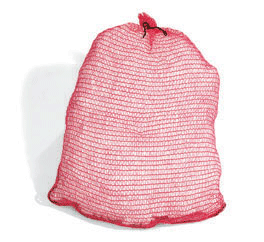
Net Bag Pillows are the perfect choice for one product to do multiple tasks. These can be used in place of pads or socks to absorb oil from a leaky drum or under leaky machiney and equipment.

Made from polypropylene strips encased in a nylon mesh bag. Durable and quick wicking.

It is also used to absorb larger spills on water.  Easy to use too, Just toss it on the spill. It floats for easy retrieval - even when saturated.

Net Bag Pillows
             Net Bag Pillow

The Net bag pillow is a large Oil Absorbent Pillow for catch basins and big spill cleaning jobs.
Generally,  pillows have a high capacity absorbent cushion that is contained within a highly visible PVC flexible tray to collect drips from machinery. 

(ii) PLANT PILLOWS (PP):  

Plant pillow is a high capacity absorbing cushion that is designed to
Absorbent Socks and Booms (ASBs) are  Long, tube-like structure  that have the configuration to conform to the shape you need around equipments or drains. It is very effective and designed to contain spills on land and water. Booms float on water to absorb the sheen from ponds, ditches, lakes and rivers.
Absorbent socks and booms are made of various types/ structural designs. These are:

(1) OIL ABSORBEN. T BOOMS (OABs):
Oil Absorbent Booms (OABs)  are of two types: (i) OIL ABSORBENT BOOM MAX  (ii) OIL ABSORBENT BOOM MINI. 
OABs are designed for rapid cleanup and containment of oil  spills on water. 

Extra durability is supported by a strong outer mesh and inner nylon rope.

Each full size boom end is outfitted with metal fasteners and washers to connect 10’ pieces into longer sections.

Filler will not shed and boom will not sink even when saturated with oil. Can be used on land or water. 


(2)  OIL ABSORBENT MINI BOOM.

Oil Only Socks soak up petroleum based fluids quickly while repelling water.

Socks float on water to absorb hydrocarbons floating on the surface.

Flexible to conform easily around equipment and between surfaces.

Excellent for both everyday use and emergency spill response.

Contains liquids before spreading to floors and walkways.

(3) OIL ONLY SOCKS (OOS):

Oil Only Socks soak up petroleum based fluids quickly while repelling water.

OOS float on water to absorb spilled hydrocarbons floating on the water surface.

It is flexible and designed to conform easily around equipment and between surfaces.

It is excellent for both everyday use and emergency spill response.

OOS Contains spilled liquids (oils) quickly before the said liquid  starts spreading to floors and walkways. It comes mainly in white Color.

 Oil only Socks (oos) works by absorbing spilled oils on water suface, while simultaneously repelling water from being absorbed into it so as to effectively contain spill and prevent spreading of the spill.  

(4) UNIVERSAL SOCKs

Universal Socks are filled with a renewable and 100% recyled cellulose blend that has been treated with a flame retardant. Please see the chart below for chemical compatibility. If you find that these socks are not compatible with your liquid, please consider the Yellow HazMat Poly Blend Socks available.

  • Excellent for both everyday use and emergency spill response.
  • Contains liquids before spreading to floors and walkways.
  • Conforms easily around equipment and between surfaces.
  • Durable sleeve withstands rough handling.
  • Color: Gray - Universal
Universal Socks are made from a renewable and 100% recycled resource.
oil absorbed socks. 


With this complete kit, remove any fear of dealing with human spills that involve body fluids such as blood or urine etc. This is a must have for school sick bay, laboratories , companies etc This kit shall help to Project your facility and prevent contamination.


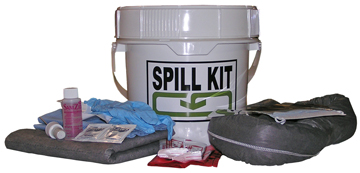
HAZMAT SPILL KITS: HAZMAT SPILL KIT: This is perfect spill kit for a laboratory, medical offices or any place where hazardous spill or body fluid spill may occur. It is a n essential kit that all HSE practitioners must provide in their Companies. 

Hazmat Spill Kit is a multi-purpose kit, ideal for schools, laboratory, medical offices, or any place where a hazardous spill  or body fluid spill may occur.

This spill kit is contained in a 2 gallon UN approved pail with screw on/off lid.

It includes personal protection products for Bio-Hazard spills. Red Z forms a leak proof gel of water based liquid.  Total Spill kit absorbs about 5 gallons.

This compact kit is all that is needed for maximum spill protection and control in the laboratory, Schools,  offices /establishments where hazardous liquids are used daily.

Contents:

  • 1 Universal Sock 3"x4'
  • 3 Universal Pads, 17"x15"
  • 1 Germicidal Solution Spray
  • 1 Face Mask w/Eye Shield
  • 2 Hand Sanitizer  Wipes
  • 1 Bio-Hazard Bag w/zip tie
  • 2 Red Z Solidifier Pouches
  • 1 Pr. Latex Gloves
  • 1 Scraper/Pan
  • Instruction Sheet
2 Gallon Hazmat Spill kit   2 Gallon Hazmat Spill Kit


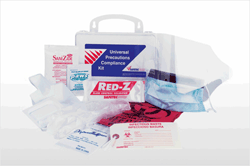
Universal Precaution KitUniversal Precaution Kit 
This kit is mainly recommended for personal protection and everything you need to clean up an infectious spill. 

Universal Precaution Kits provide personal protection and are a responsible method for the clean up of infectious blood and body fluid spills.  

  • This Spill Kit has all the items mandated by OSHA, CDC and state health departments.
  • Use alone or add to any Spill Kit for complete coverage.
  • Red Z™ Solidifiers provide state-of-the-art response for spill control and clean-up of potentially bio-hazardous fluids. Captures and retains up to 100 times its own weight.

CONTENTS INCLUDES:

  • Red Z™ Solidifier
  • p.a.w.s antimicrobial hand wipe
  • wiper pads
  • vinyl gloves
  • combination mask/face shield
  • scoop/scraper
  • apron
  • biohazard red bag
  • identification tag
  • intructions

Wednesday, 24 August 2016

HEALTH RISKS ASSOCIATED WITH GETTING PREGNANT AT AGE 35 AND ABOVE

The biological clock of women is an astonishing fact of life, and there's actually nothing magical or spiritual about age 35, and more, in women. It's simply just an age at which various health risks become more at play and as such becomes discussion worthy.

The biggest obstacle for women age 35 or older may be getting pregnant in the first place. Fertility rates begin to decline gradually at aged 30, more so at 35, and markedly at age 40. Even with fertility treatments such as in–vitro fertilization, women have more difficulty getting pregnant as they age.
Studies have shown that in women it might take longer to get pregnant at age 35 and above than the younger ages. 
As a woman reaches her mid- to late 30s, her eggs decrease in quantity and quality. Also in older women, the eggs aren't fertilized as easily as that of the younger woman's eggs. 

As a matter of fact, older women ,especially those at 45 and older rarely get pregnant, even with fertility treatment. Fertility specialists routinely recommend oocyte donation ( IVF with eggs donated by a young egg donor) for these women because pregnancies with their own eggs are so rare.

We've always advised all women who are older than 35 and haven't been able to conceive for six months and more, to quickly consider asking their health care providers for advice.

Infertility evaluation is generally recommended for women who have been trying to get pregnant for 12 months or longer. But if you're 35 or older, don't wait a whole year. Get an evaluation after six months, or sooner if you suspect that something may not be right – such as if your periods aren't regular, or if you've had previous abdominal surgery.
 Again, studies have shown that older women are more likely to have multiple pregnancies than their young female counterparts. The chance of having twins increases with age in women. As such, the use of assisted reproductive technologies — such as in–vitro fertilization — can very well play a good role. 

Older women are more likely to develop gestational diabetes. This type of diabetes, which occurs only during pregnancy, is more common as women get older. Hence, tight control of blood sugar through diet and physical activity is very essential. Sometimes medication is needed, too. If left untreated, gestational diabetes can cause a baby to grow significantly larger than average — which increases the risk of injuries to mother during delivery. 

Pre-eclampsia, placental abruption (in which the placenta prematurely separates from the uterine wall), and placenta previa 
(in which the placenta lies low in the uterus, partly or completely covering the cervix).
Research also shows that your chances of having a low-birth-weight baby (less than 5 1/2 pounds) or a premature delivery increase with age. Some studies show that older women are more likely to need pitocin during labor, and most studies show a significantly higher rate of delivery by cesarean section.

Older women are more likely to develop high blood pressure during pregnancy.
Research suggests that high blood pressure that develops during pregnancy is more common in older women. Your health care provider will carefully monitor your blood pressure and your baby's growth and development. You might need to take medication or deliver your baby before your due date to avoid complications. 

Women who are 35 and above are more likely to have a low birth weight baby and a premature birth. Premature babies, especially those born earliest, often have complicated medical problems. 

Women who are of age 35 and above might have a higher probability of needing a C-section. Older mothers have a higher risk of pregnancy related complications that might lead to a C-section delivery, such as placenta previa — a condition in which the placenta blocks the cervix. Women also have more trouble staying pregnant as they get older: The rates of miscarriage and ectopy pregnancy go up substantially with age.

The risk of chromosome abnormalities is also higher in women of age 35 and above.. Babies born to older mothers have a higher risk of certain chromosome problems, such as Down syndrome. 

The risk of pregnancy loss is also higher in older women . The risk of pregnancy loss (by miscarriage and stillbirth) increases as women get older, perhaps due to pre-existing medical conditions or fetal chromosomal abnormalities. You need to ask your health care provider about monitoring your baby's well-being during the last weeks of pregnancy.


Women who give birth at 35 or older have a higher risk of Stillbirth and maternal death  The increased risk is largely due to underlying medical problems more common in older women. Proper diagnosis and treatment will help reduce the risks for you and your baby.

If you're considering getting pregnant, see your doctor or midwife for a thorough examination. Your provider will take a detailed medical and family history of both prospective parents to identify conditions that might affect your pregnancy or your chances of getting pregnant. You can manage many of the risks of pregnancy at age 35 and up by seeing your doctor or midwife regularly for good prenatal care.

Make healthy choices
Taking good care of yourself is the best way to take care of your baby. Pay special attention to the basics:

Make a preconception appointment: 
Talk to your health care provider about your overall health and discuss lifestyle changes that might improve your chances for a healthy pregnancy and baby. Address any concerns you might have about fertility or pregnancy. Ask about how to boost the odds of conception — and options if you have trouble conceiving. 

Seek regular prenatal care. 
Regular prenatal visits help your health care provider monitor your health and your baby's health. Mention any signs or symptoms that concern you. Talking to your health care provider is likely to put your mind at ease. 

Eat a healthy diet. During pregnancy, you'll need more folic acid, calcium, iron, vitamin D and other essential nutrients. If you're already eating a healthy diet, keep it up. A daily prenatal vitamin — ideally starting a few months before conception — can help fill any gaps. Gain weight wisely. Gaining the right amount of weight can support your baby's health — and make it easier to shed the extra pounds after delivery. Work with your health care provider to determine what's right for you. 

You must stay active all the time.  
Regular physical activity can help ease or even prevent discomfort, boost your energy level and improve your overall health. It can also help you prepare for labor and childbirth by increasing your stamina and muscle strength. Get your health care provider's OK before starting or continuing an exercise program, especially if you have an underlying condition. 

Avoid risky substances. 
Alcohol, tobacco and illegal drugs are off-limits during pregnancy. Clear any medications or supplements with your health care provider ahead of time. 

Learn about prenatal testing for chromosomal abnormalities. 
Ask your doctor about noninvasive prenatal testing, a blood test that examines fetal DNA in the maternal bloodstream to determine whether your baby is at risk of certain specific chromosomal abnormalities. Diagnostic tests such as chorionic villus sampling and amniocentesis provide information about your baby's chromosomes or the risk of specific chromosomal abnormalities, but also carry a slight risk of miscarriage. Your health care provider can help you weigh the risks and benefits.

Look toward the future
The choices you make now — even before conception — can have a lasting effect on your baby. Think of pregnancy as an opportunity to nurture your baby and prepare for the exciting changes ahead.
Make sure you do all above as advised, and your chance of having a healthy baby should be similar to that of younger women who are also in good health.

Wednesday, 17 August 2016

INTEGRATED PEST MANAGEMENT (IPM)

INTEGRATED PEST MANAGEMENT (IPM)
Integrated Pest Management (IPM) is a long-term management strategy that uses a combination of techniques to reduce dangerous pests to tolerable levels with potentially lower costs for the individual and minimal effect on the environment. The principles of integrated pest management includes:

(a) Identify pests, their hosts and beneficial organisms before taking action.

(b) Establish monitoring guidelines for each pest species.

(c) Establish an action threshold for the pest.

(d) Evaluate and implement control tactics.

(e) Monitor, evaluate and document the results.

IPM can be applied when managing all kinds of pests, including insects, weeds, diseases and vertebrate pests, such as rats/mice ,snakes, squirrels and birds. It integrates prevention, cultural practices, mechanical and/or physical pest controls, biological pest controls to prevent and suppress pests. However, Chemical pest control should be a last resort measure as IPM deemphasizes chemical application unless its a last resort as mentioned earlier. This is because the goal of IPM is to reduce the adverse impacts of dangerous pest on human health, the environment and non-target organisms, while managing the dangerous pests effectively.
The Environmental Health practitioner is saddled with the huge responsibility of protecting and conserving the environment such that the environment would be safe for man, animals and indeed all other creatures on the planet while controlling the population of dangerous vertebrate and invertebrate animals including microbes. Hence, it would be a great disservice to deliberately exterminate innocent, non dangerous and friendly animals, birds, insects, marine dwelling creatures etc with the mere excuse of controlling pests in the environment. Such professional recklessness could definitely alter the ambience of the ecosystem. After all not all animals, birds and insects are dangerous to man.
Infact some creatures (insects,  birds etc) are very significant to man's healthful living in the environment. As such, Chemicals (especially liquid spray chemical formulations) kills both target and non target insects and small animals which is not in line with IPM principles.

The concept of Integrated Pest Management is not new and has been in use throughout the world. Applying IPM in urban environments, including home gardens, landscapes and golf courses, presents special challenges. Urban IPM, or pest management programs that incorporate reduced use of pesticides in private and commercial landscapes, golf courses and other urban landscape settings, is a rapidly expanding field that incorporates university and industry research.

VERTBRATE PEST MANAGENT

Vertebrate pests include animals with a backbone, such as rats/mice, snakes etc. In line with IPM principles, vertebrate pests is best managed using the following technics:

1. Exclusion:
Exclusion is the practice of keeping the pest out of or away from (farms, crops,  buildings, etc. Using barriers, such as fencing and durable materials, to plug entrances into buildings or prevent animals from accessing your premises, gardens, lawns or landscape plants, are examples of exclusion practices. Fences must be sized according to the type of pest to be excluded.To be effective, exclusion fences must be at least 6 feet tall. Some experts recommend the fence be 7 to 8-feet tall.

(2.) Good hygiene and Sanitation
This is especially important for areas like kitchens, residences and areas where animals are kept. Eliminate food and water sources. Store food and animal feeds, grain and seed in rodent-proof containers. Repair leaky pipes. Sanitation is very important for managing vertebrate pests in yards. Avoid leaving food remnants,  fruits and vegetables where they are accessible to pests. Cover your compost pile.

(3.) Trapping:
There are several types of kill traps and live traps available for most vertebrate pest species. It is essential to choose the proper trap and learn the correct way to use it. Live trapping and releasing the pest is neither acceptable nor legal. Individuals who release live-trapped animals are moving the pest problem and sometimes diseases like rabies, distemper or plague along with them. Live trapping followed by an approved method of euthanasia is recommended. When using live traps, do NOT relocate pest animals.

(4.) Repellent:
In agricultural application new growth on plants must be retreated, and animals may easily get used to the repellent and resist it.Repellants may be applied to valuable vegetation or can be used in areas where pests are known to frequent. They often don't work the way people expect them to work. Sunshine can break down the repellent, and sprinklers and rain can wash away the product.

(5.) Rodenticide Baits:
Baits such as seeds, grains and vegetation treated with rodenticides are used to control several types of vertebrate pests. Most baits must be applied in bait stations or underground within animal burrows to lessen the risk of killing of non-target species. Pesticide labels describe methods for applying the bait. Pesticides used include strychnine, zinc phosphide and various anticoagulants. Strychnine may only be applied underground.

(6.) Fumigants:
Smoke bombs and various types of internal combustion engines produce poison gases, including carbon monoxide, that can be used as fumigants. This is a very dangerous method that should be avoided by residential home owners.

To be effective, all burrow entrances must be blocked. When using smoke bombs, avoid areas near structures,  stacks, etc. Aluminum phosphide fumigants are available either as tablets or pellets. When applied in rodent burrows, they produce phosphine gas, which is deadly. Applied improperly, aluminum phosphide has resulted in numerous human deaths. To purchase, apply or supervise the use of this pesticide, applicator must be certified and duely trained by the Rivers State Ministry Of Environment. Residential home owners CAN NOT use these products at home.

WHAT IS INTEGRATED PEST MANAGEMENT?

Integrated Pest Management (IPM) is a well managed pest control system that:

(1.) Eliminates or mitigates economic and health damage caused by pests;

(2.) Minimizes the use of pesticides and the risk to human health and the environment associated with pesticide applications;

(3.) Use integrated methods to successfully carry out pest infestation assessments, inspections, pest population monitoring, an evaluation of the need for pest control program, and one or more pest control methods, including sanitation, structural repairs, mechanical / living biological controls and indeed other non-chemical methods.

A well-defined Integrated Pest Management (IPM) is a program that should be based on prevention, monitoring, and control which offers the opportunity to eliminate or drastically reduce the use of pesticides, and to minimize the toxicity of and exposure to any products which are used. IPM does this by utilizing a variety of methods and techniques, including cultural, biological and structural strategies to control a multitude of pest problems.

IPM is a term that is used loosely with many different definitions and methods of implementation. IPM can mean virtually anything the practitioner wants it to mean.Beware of chemical dependent programs masquerading as IPM.

Those who argue that IPM requires the ability to spray pesticides immediately after identifying a pest problem are not describing IPM. Conventional pest control tends to ignore the causes of pest infestations and instead rely on routine, scheduled pesticide applications. Pesticides are often temporary fixes. They get ineffective over time.

The Six IPM Program Essentials

(1.) Monitoring:
This includes regular site inspections and trapping to determine the types and infestation levels of pests at each site.

(2.) Record-Keeping:
A record-keeping system is essential to establish trends and patterns in pest outbreaks. Information recorded at every inspection or treatment should include pest identification, population size, distribution, recommendations for future prevention, and complete information on the treatment action.

(3.) Action Levels:
Pests are virtually never eradicated. An action level is the population size which requires remedial action for human health, economic, or aesthetic reasons.

(4) Prevention:
Preventive measures must be incorporated into the existing structures and designs for new structures. Prevention is and should be the primary means of pest control in an IPM program.

(5.) Tactics Criteria: 
Under IPM, chemicals should be used only as a last resort only, but when used, the least-toxic materials should be chosen, and applied to minimize exposure to humans and all non-target organisms.

(6.) Evaluation:
A regular evaluation program is essential to determine the success of the pest managent strategies.

           ADVANTAGES OF 
INTEGRATED PEST MANAGEMENT (IPM)

There are many advantages in using the IPM pest management approach:

Maintaining a Balanced Ecosystem
The Ecosystem comprises living and non-living components that are intricately linked as effects of one species within the system may affect other species (positively or negatively) due to the reliance on different trophic levels. Ideally, and in many cases this is true, functional redundancy is present within a system, and organisms can adapt as the ecosystem evolves and species composition changes at different trophic levels. 
Using chemical controls can reduce pests, but may also reduce species of organisms that reduce pest species themselves within the ecosystem. By using an IPM approach, we aid in maintaining ecosystem stability while controlling pest problems.


 Examples of some preventative IPM techniques:

1.) Cultural Controls (i.e., changes that disturb the natural environment of the pest) 
2.) Structural Modifications, 
3.) Biological Controls (i.e., beneficial organisms), 
4.) Physical Barriers, 
5.) Use of Pheromones (i.e., natural insect scents), 
6.) Pest-Resistant Varieties

Monitoring is an important component of the IPM strategy. Monitoring involves:
i.)  Regular checks of the area 
ii.) Early detection and 
iii.) Documentation of pests 
iv.) Proper identification of pests
v.) Identification of the effects of biological control agents

Assessment is the process of determining the potential for pest populations to reach an economic threshold (i.e., depletes the value of the crop below an established bottom line) or an intolerable level. Keep records from previous years so you can refer back to them. Watching the weather patterns and historical data will give you a good idea when and if a pest problem may occur.

One also needs to determine the action needed in order to address the pest problem. If pests reach an economic threshold (farmers) or intolerable levels ( in homes), swift professional pest control action must be taken. When no other strategy would bring the pest population under a tolerance threshold, then the use of chemical pesticides is probably justified - if applied properly (i.e., according to label standards). 

At this point, use of chemical pestcides would be needful.  A professional decision-making toolbox will be an important component of the final measures taken in order to neutralize a pest problem. Use of the data portal will also be a critical component in final decisions as it will increase the accuracy of impact assessments of a pesticides based on geographical characteristics as well as the physical and chemical properties of the pesticide. You have now taken the necessary steps to assess your pest problem and the different possible solutions. 

When you are making your final decision for pesticide application, consider upcoming storm events, wind speed, and where you are in relation to water and what floodplain zone you are in (data portal). Also, make sure to use appropriate PPE and application rates and methods listed on the label. These tools will ultimately lead you to the appropriate pesticide for your pest situation.

Tuesday, 9 August 2016

FAMILY HEALTH HISTORY

Family members share genes, behaviors, lifestyles, and environments that together may influence their health and their risk of chronic disease. Most people have a family health history of some chronic diseases (e.g., cancer, coronary heart disease, and diabetes) and health conditions (e.g., high blood pressure and hypercholesterolemia). People who have a close family member with a chronic disease may have a higher risk of developing that disease than those without such a family member. Family health history is a written or graphic record of the diseases and health conditions present in your family. A useful family health history shows three generations of your biological relatives, the age at diagnosis, and the age and cause of death of deceased family members. Family health history is a useful tool for understanding health risks and preventing disease in individuals and their close relatives. Some people may know a lot about their family health history or only a little. It is helpful to talk with family members about your health history, write this information down, and update it from time to time. This way family members will have organized and accurate information ready to share with their health care provider. Family health history information may help health care providers determine which tests and screenings are recommended to help family members know their health risk.